



Introduction to Port Wireless Communication
With the development of national economic construction, port business has developed rapidly. Both inland ports and import and export ports have put higher and higher requirements on the digitization of port business construction. Digital port is the direction of port business development.
The port is a very typical wireless application scenario. Ports, docks and cargo yards cannot be laid with cables due to large-scale port machine operations. Wireless broadband access provides an ideal solution. In addition to avoiding the difficulties of laying line infrastructure in concrete and oceans, this solution also provides broadband access for ships docked in harbours and docks.
The wireless communication access method has the characteristics of high mobility, strong confidentiality, anti-interference, and convenient installation and maintenance, and is particularly suitable for the construction of port and wharf networks.
solution:
The wireless communication access method can help the terminal technical department to realize the remote monitoring and maintenance of HAECO. Relevant technical personnel can know the work status, fault location, maintenance parts and other information of HAECO equipment without leaving the office, which greatly improves the efficiency of inspection and maintenance of HAECO equipment. The fault judgment is more accurate and the fault handling is faster.
A single base station equipment provides wireless access to HAECO in a covered manner. The wireless communication access method can replace the expensive towline optical cable to achieve reliable and stable data transmission.
The schematic diagram is as follows:
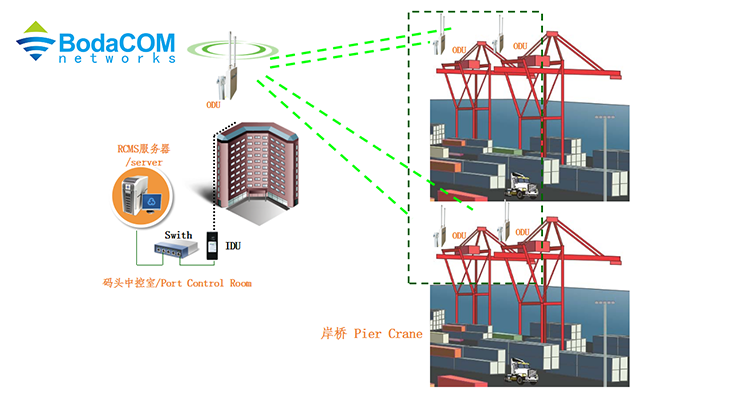
Main features of the system:
1. The construction is fast to avoid damage to the ground and roads of the dock;
2. Meet the radio frequency and equipment requirements of the port environment;
3. High wireless transmission bandwidth, can provide 10-500Mbps transmission bandwidth. Meet the bandwidth requirements of different applications in ports;
4. The system network structure is simple, and supports multiple access methods such as MESH, point-to-point, and point-to-multipoint. A single base station can provide access for multiple port machines or port units, greatly saving system investment;
5. The wireless transmission distance is long, and the single base station can cover a radius of more than 5KM to meet the use of the terminal environment; 6. The system uses multiple encryption methods such as AES encryption, IP address, and MAC address restrictions, and the security meets the requirements of the port;
7. The system meets the IP67 protection standard and is designed to resist corrosion. It is particularly suitable for 24-hour continuous work in the harsh environment of the port;
8. The system can simultaneously meet the integrated service access of video, data, voice, etc., and fully protect the port investment.
 鲁公网安备 37010102001611号